Sally’s Game Design Portfolio
Hi! I’m Sally, a Game Design and Computer Science double major at New York University. I care about creating games that hook players, offering them experiences that feel rewarding AND replayable.
I love designing mechanics that blend or redefine genres, whether it’s a Victorian murder mystery game set in the world of Sherlock Holmes or a family card game about kittens in space.
I currently teach programming and 3D modeling at MakeInspires, and work with Dead Alive Games on development, playtesting, and community engagement.
Whether it’s through clever mechanics or meaningful narratives, my goal is to make games that make an emotional impression and satisfy players: not just once, but every time they play.
About Me

Digital Games
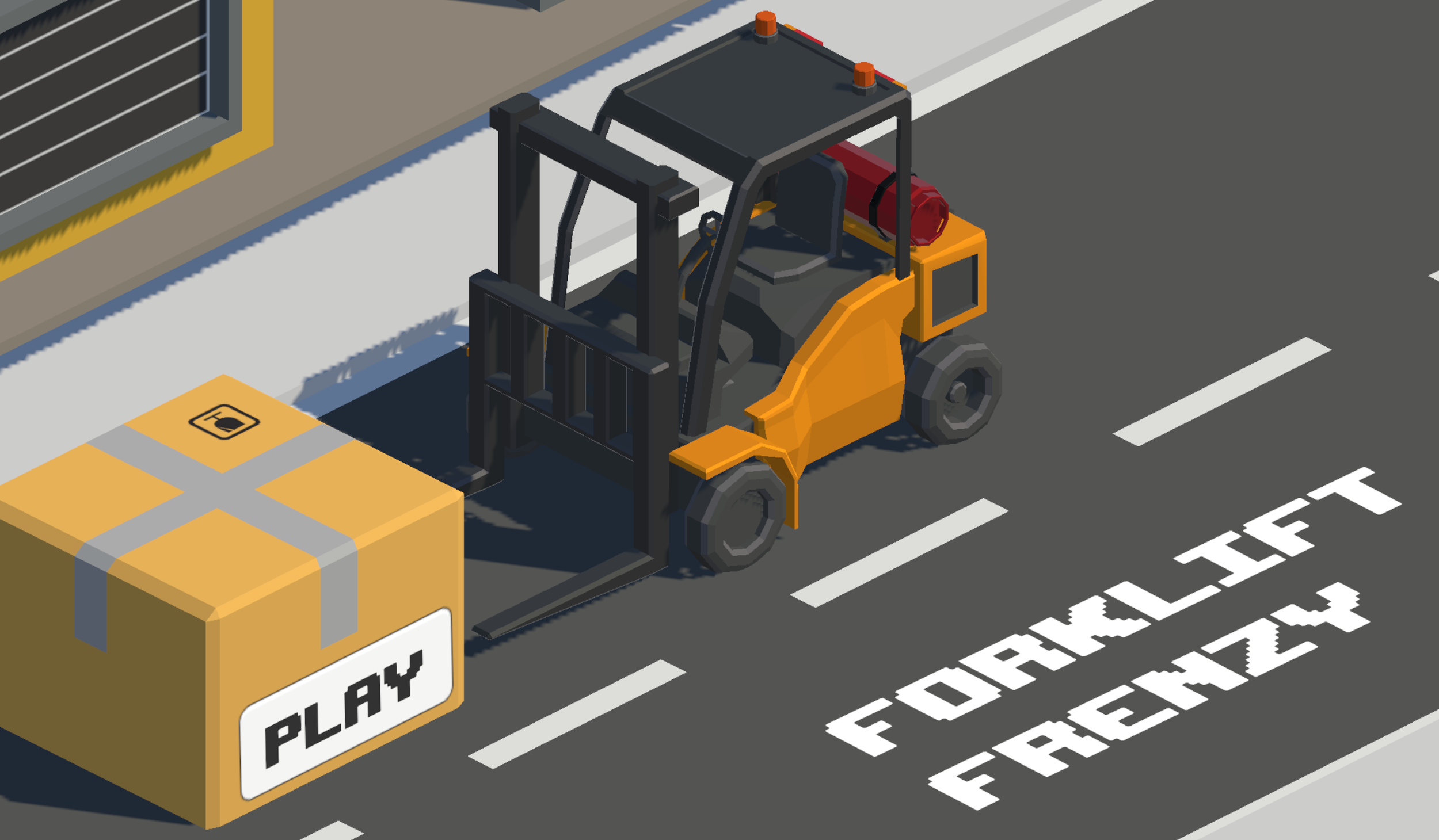

Forklift Frenzy: Programmer, Designer
Core Concepts: Area Design, Puzzle Systems
A 3-level Sokoban.
Made in 3 weeks for a class project.
Elmer and the Dragon: Designer, Writer
Core Concepts: Narrative Design, IP use, environment-based puzzle solving.
A narrative game based on My Father’s Dragon.
Made in one month for a class project.
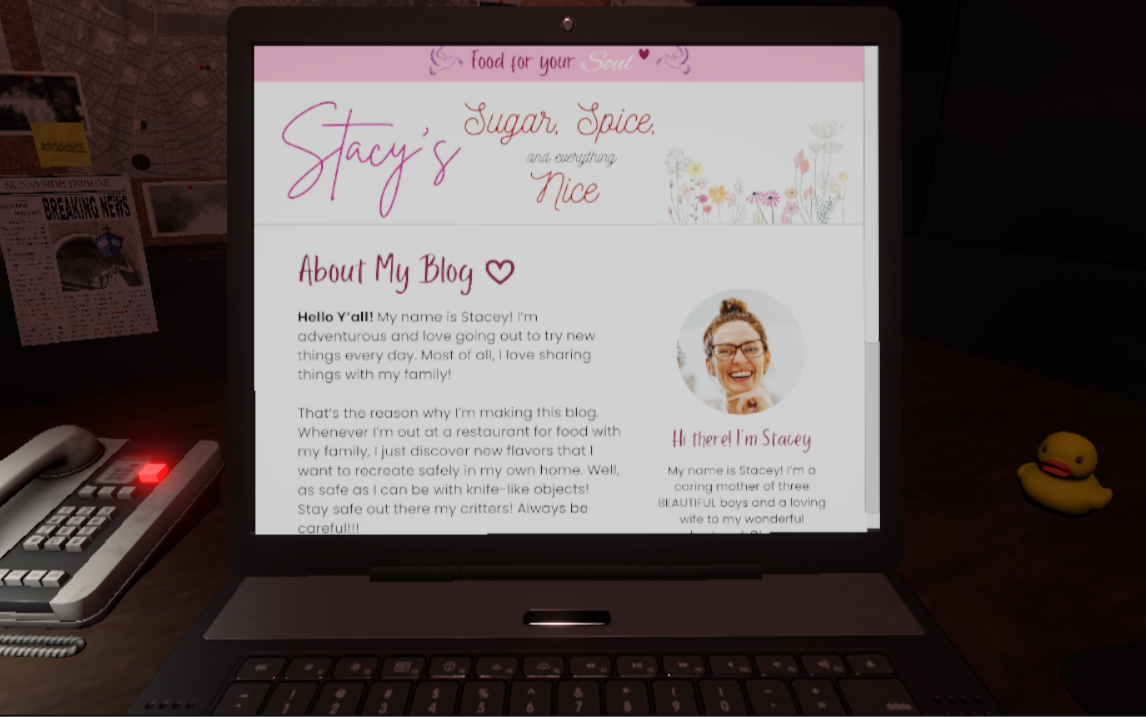
Happy Cooking: Programming Lead
Core Concepts: Lighting and Mood, Perception-Driven Space
A satirical cooking blog horror story. Made in one month.
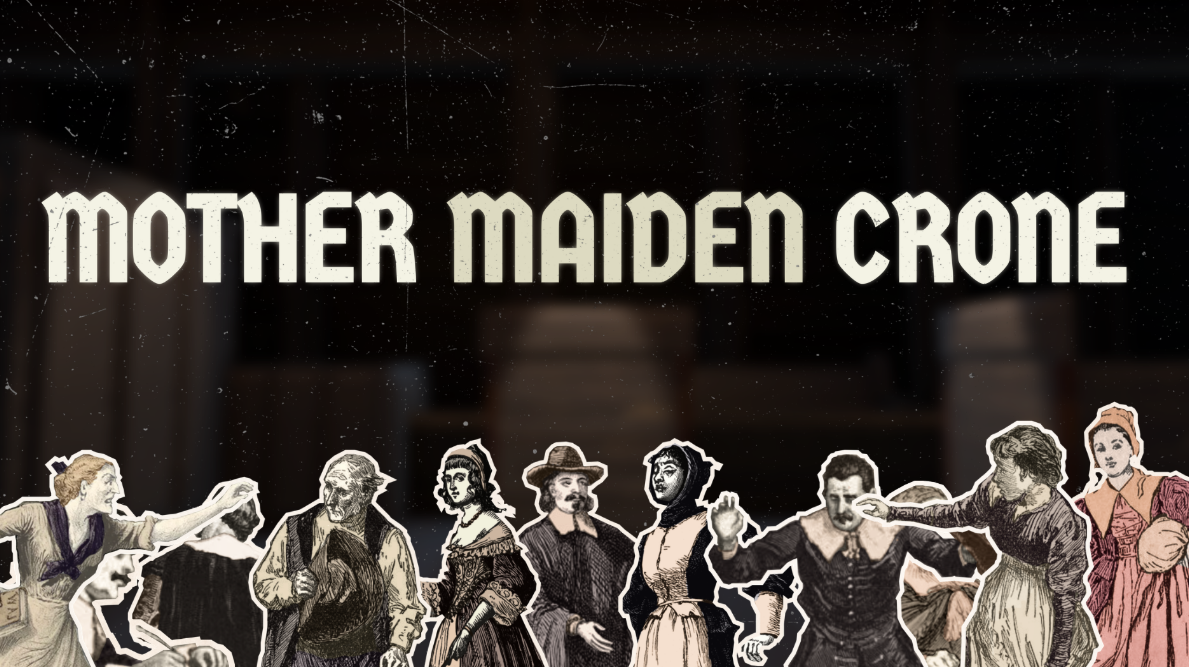
Mother, Maiden, Crone: Project Lead
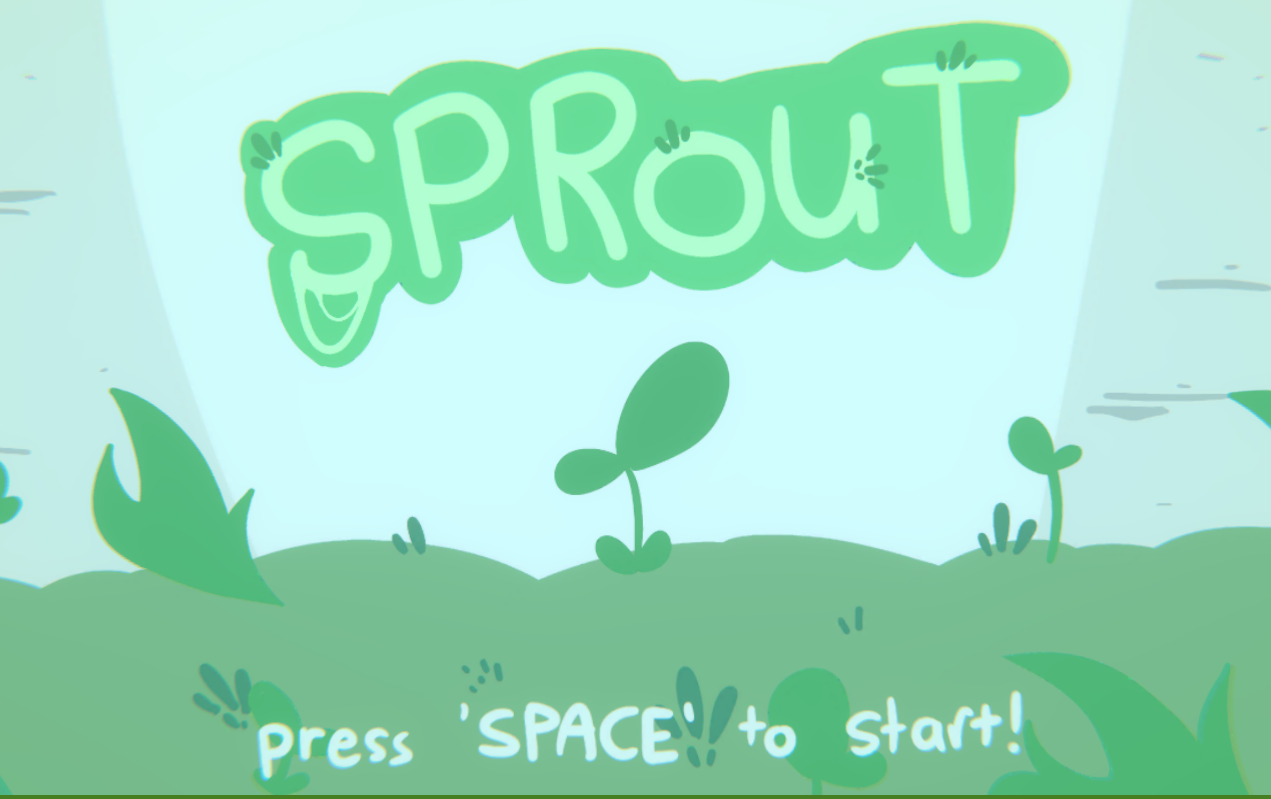
Sprout: Game Design Lead, Writer
Core Concepts: Spatial & Ecosystem Design, Player Flow
An interactive gardening sandbox set in an alien forest.
Made in 3 Weeks for Cause Jam 35.
Core Concepts: Environmental Narratives, Authored Player Movement, Historical Fiction
A story about 3 woman facing the perils of a witch trial, based on my ancestral history.
Tabletop Games
Kittens in Space: Expansion and Solo Mode Development

A Card-Shedding Game for 1-6 Players
-
In Kittens in Space, you’ll race to rescue and rehome adorable cosmic cats before your opponents can. Play cards on multiple shifting stacks, balancing luck and strategy, and be the first to shed your hand to win. With a stunning performance on Kickstarter, Kittens in Space surpassed its $3,000 goal and recieved over $61,000 in pledges.
-
Created and ran the Your Cat Among the Stars campaign to promote the Kickstarter and ad. Used data-driven tools to track engagement and process campaign entries on a large scale.
Researched the product and audience to determine key development and player needs.
Lead QA and playtesting sessions to gain an understanding of key issues and concerns with the product.Proposed and implemented a new solo mode opponent system, defining how the AI opponent behaves and interacts with player actions.
Designed two new expansion cards, including concept, mechanics, and balance testing. -
Learned how to document, justify, and communicate design choices in a professional studio environment.
Developed ability to break down complex design problems and output tangible solutions through playtesting and iteration.
Learned how to generate large-scale player engagement projects to generate new Kickstarter pledges.
Gained hands-on experience in tabletop development, including design iteration, rule writing, and balancing mechanics.Developed a deeper understanding of solo mode design, mechanic adaptation, and how to preserve thematic and mechanical cohesion in expansions.
Billie’s Back: Designer and Writer
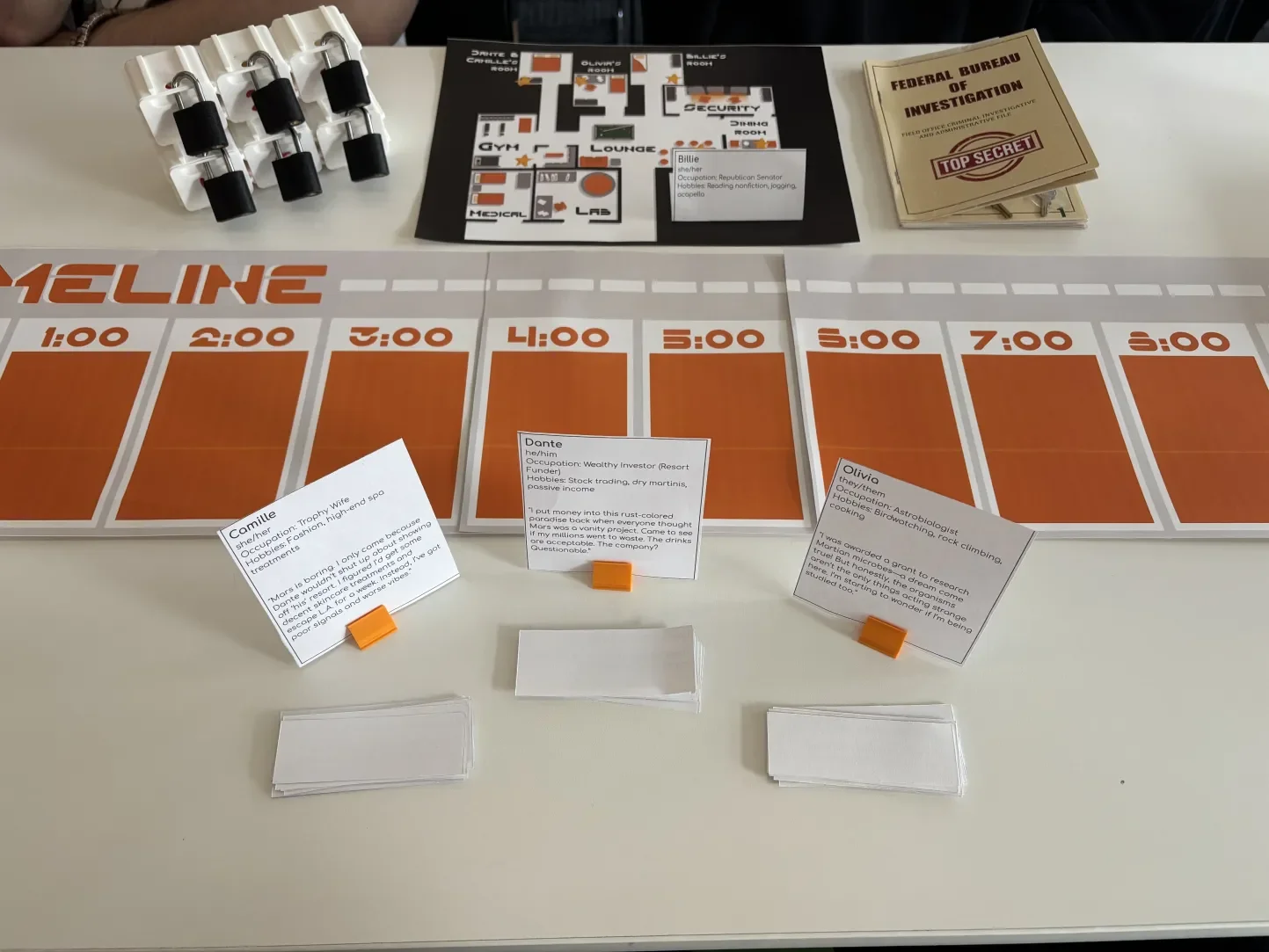
A Social Deduction/Storytelling Game for 3-4 Players
-
This game was selected to represent the class of 2028 for the NYU GDC Showcase in 2025.
In Billie’s Back, you play as a tourist on their dream vacation… in space! Your adventure takes a chilling turn, however, when a fellow tourist is found dead. When a team of intergalactic investigators arrives, can you prove that you’re innocent? -
Note: I am the project lead, one of four student designers.
Lead the design process by delegating to and collaborating with interdisciplinary team of designers.
Wrote the full Investigation Booklet, including main events, clue reveals, and narrative structure guiding each phase of play.
Lead QA and playtesting sessions to ensure the game met quality standards throughout the production process.Developed tone and pacing to balance humor, suspense, and deduction in a social setting.
Created all player bios and character backstories to support the game’s mystery framework.
Designed, modeled, and 3D printed all miniature clue props, integrating them into the game’s core loop to support tactile storytelling.
-
Learned to balance interactive narrative pacing with deduction-based gameplay.
Strengthened ability to write distinct, interconnected character voices that drive group storytelling.
Gained hands-on experience in 3D prototyping and physical storytelling through custom clue props.
Developed a deeper understanding of how narrative design and tactile design work together to shape player immersion.
Karens vs. Humanity: Game Design

A Satirical, Co-Op Card Game for 2-4 Players
-
Karens vs. Humanity is a cooperative strategy card game that turns the traditional hero-versus-villain formula on its head. Players take on the roles of “Karens,” exaggerated avatars of entitlement and frustration, teaming up to drain humanity’s sanity before their own morale collapses. In this game, anyone can be a 'Karen’. Blending humor, social commentary, and tactical play, the game uses qualities like Drama, Entitlement, and Rage as both comedic core mechanics and a message about empathy, self-awareness, and modern social conflict.
-
Note: I am one of three student designers.
Developed and refined the game’s core systems, including the Morale Bar, Sanity Bar, and Dialogue Card mechanics.Designed the Cache of Consciousness system, a randomized dialogue mechanic simulating spontaneous thought in argument-based encounters.
Created the game’s satircal voice through writing and playtesting.
-
Learned how to translate satire into tangible mechanics, designing systems that make humor an active part of play.
Strengthened my understanding of cooperative balance, randomness, and pacing in team-based games. Through iteration and collaboration,
Learned how to simplify complex ideas into clear, engaging mechanics that support both strategy and storytelling.
The Jewell in the Copper: Design and Writing

Interactive Mystery Narrative, Inspired by Sherlock Holmes: Consulting Detective
-
The Jewell in the Copper is an original mystery designed in the style of Sherlock Holmes: Consulting Detective. When a young nun named Sister Engels, an overseer at a Magdalene Laundry, is pushed into a copper vat of boiling water, the police are mystified. How could something like this happen in a respected Catholic Institution? And why was Sister Engels, a holy woman, spotted in a tavern in Spitalfields the night before the murder? In The Jewell in the Copper, players must nagivate a mysterious underworld of religious beurocracy, corruption, and sinister intentions— all while discovering the true identity of the woman they thought was innocent.
-
Note: I am one of three student designers.
Created and designed the narrative setting of 1890s London, drawing from historical research on Magdalene Laundries, Victorian social systems, and real-world religious institutions. Researched real archival documents, including registries, street directories, and newspaper clippings to shape the historical accuracy of the story.Wrote and edited passages across the investigation, including interrogations, environment descriptions, and the opening case briefing.
Worked with a team of writers to maintain narrative cohesion, continuity, and pacing across interconnected story threads. Developed core narrative paths and worked to create and test these collaboratively.
-
Learned how to create a narrative game based on and set in the world of a previously established IP.
Strengthened my ability to balance and streamline narrative style and tone across a team of different writers.
Learned how to create a ludonarrative structure based on historical documents, mimicing the language and culture of that era as much as possible.
Learned how to create a non-linear narrative mystery, guiding players across three variable narrative paths.
Hold the Floor: Design

A Lewd, Unrealistic Social Party Game about Filibusters.
-
Have you ever wanted to be a senator in Congress? Now’s your chance! Argue your own bills while stalling your opponents using improvised filibusters - but with a twist. Due to the new Anti-Boredom Act, filibusters must be sufficiently entertaining. Can you make a point, put up a good show, and keep your face straight at the same time?
In Hold the Floor, players must filibuster to convince the audience that a new, ridiculous law, must be passed— all without laughing. -
Note: I am one of four student designers.
Created and designed the concept of comedic, social-interaction-based filibusters. Created key roles and interactions for each player.Playtested and designed the core gameplay loop, including shaping the timing and structure of filibusters and crowd involvement.
Established the story’s comedic tone. Wrote and designed the majority of the Speaker Cards.
Worked with a team of designers to create and develop unique social interactions for players.
-
Gained experience designing and developing a social game, focusing on the physicality and comedy of verbal gameplay.
Learned how to create a game based on a specific audience (close friends) and setting (party).
Pitches, Concepts, and Essays
Crone: A Witch’s Tale

Beetlejuice: House of Tricks

Evil Inc: Corporate Assimilation in Games

Playing the Conqueror: Native American Representation and Digital Manifest Destiny in Video Games
